













First kit for a PPL or LAPL student: buy now, borrow or wait
After reading you'll know what to ask your school before you spend anything, which items are worth having for the first lessons and which can wait until you know you're carrying on. Part-FCL asks one thing of you, a logbook; everything else is the school's preference.
Ask the school first
Part-FCL has no list of personal equipment. FCL.050 requires a reliable record of your flights, and neither it nor the course requirements in FCL.110.A (LAPL) and FCL.210.A (PPL) name a headset, plotter or computer. Each school sets its own list, and schools differ in what they lend. Ask your instructor which headset they lend for the early lessons, which flight computer and plotter they teach with, whether distances are worked in nautical miles or kilometres, and whether a kneeboard is expected. The minimum course is 45 hours of instruction for a PPL(A) and 30 for a LAPL(A), a long road, so buy in steps.
Logbook and headset: the first two
FCL.050 leaves the form and manner of the logbook to your national authority. AMC1 FCL.050 gives a layout of twelve numbered columns and allows it to be kept electronically, provided it holds all the required items, you certify it and your authority accepts the format; ask the school whether it does. Paper entries go in ink or indelible pencil. Flights on the same day from and back to the same place, with no more than 30 minutes between them, may be entered as one. Solo time can be logged as PIC, while instruction and supervised time need your instructor's certification.
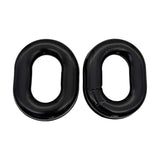
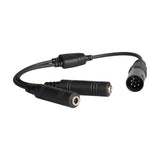
If you buy one thing before lesson one, make it a headset, after asking whether the school lends one. A passive headset is a sound choice for training, and ANR can wait until you know you'll keep flying. The plug depends on the aircraft: the PilotStyle PS221 is a passive GA headset with twin plugs (PJ-055 and PJ-068), a noise-cancelling electret microphone, an inline volume control and a 24 dB NRR rating from the maker. Fit depends on the aircraft type and the intercom, so confirm both first. Our guide to choosing an aviation headset goes through the plugs and the noise reduction.
Chart, plotter, computer and kneeboard
Learn navigation on paper first and add an app later. The chart to use is your country's official ICAO 1:500 000; in Czechia it is issued by the ŘLP AIM Centre (AIP GEN 3.2). Check the edition date, as corrections between editions are published as AIP amendments.
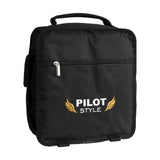
The PilotStyle PS902 training set bundles the PS220 cross-country bag, PS301 rotating azimuth plotter, PS302 square protractor, PS501 VFR kneeboard, PS600 hardcover logbook and PS601 logbook cover, about 20% cheaper than buying the six separately. It contains no headset, no flight computer and no chart, so those come on top. The PS301 has nautical-mile and statute-mile scales only and no kilometres; if your school works in kilometres, ask for a plotter with km scales. For the computer, check whether the school uses an E6B or a circular type; the PS402 is an E6B. A kneeboard is optional until your instructor says otherwise.
Sunglasses, and what can wait
Pilot sunglasses are covered by FAA and UK CAA guidance. The FAA brochure does not recommend polarised lenses: they can dim or blank displays with anti-glare filters, exaggerate striations in laminated windscreens and mask the sparkle of reflections from another aircraft. The UK CAA makes the same point about LCD displays and multi-layer windscreens, and adds that photochromic lenses adjust too slowly. The FAA recommends a neutral grey tint, no tint that blocks more than 85% of visible light, 99 to 100% UV protection and a frame that doesn't interfere with the headset, worn with a strap.
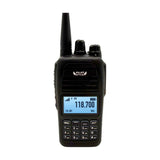
A handheld radio, a GPS, an ANR headset, a flight jacket and your own checklists can wait until you know the aircraft and your instructor's habits.
Before lesson one
- Ask what the school lends and what your instructor expects you to bring.
- Logbook in hand, in the AMC1 FCL.050 layout, and ink to fill it; ask whether an electronic one is accepted.
- Headset that fits the aircraft's plugs, or one borrowed from the school.
- Latest edition of your country's ICAO 1:500 000 chart.
- Plotter and protractor in the units your school uses; a flight computer of the type it teaches.
- Sunglasses: neutral grey, non-polarised, UV-protective, with a strap.
- Postpone the handheld radio, GPS and ANR.
Quiz: Sunglasses for the first flight
Your first lesson is next week and the forecast is bright. The shop assistant recommends dark polarised sunglasses because they cut glare the most. What do you buy? Click an answer.
A) The polarised pair; less glare is better in a cockpit.
No. The FAA does not recommend polarised lenses for flying: they can dim or blank displays with anti-glare filters, exaggerate striations in laminated windscreens and mask the sparkle of reflections from another aircraft. The UK CAA also warns about LCD displays.
B) Photochromic lenses that darken by themselves in the sun.
No. The UK CAA says photochromic lenses are slow to adjust, for example when you descend through cloud, and the FAA adds that they respond poorly to the reduced UV inside a cockpit.
C) Neutral grey lenses with UV protection, not polarised, in a frame that fits under the headset.
Correct. That is the FAA's recommendation: neutral grey, 99 to 100% UV protection and frames that don't interfere with the headset. The UK CAA's guidance points the same way on polarised and photochromic lenses.