Does ELT 345 contain its own GPS receiver?
No. It has a navigation interface that encodes valid position supplied by a compatible aircraft GPS source.
Which frequencies does it transmit?
406.040 MHz for Cospas-Sarsat alerting and 121.5 MHz for local homing.
What is included in P/N 8102?
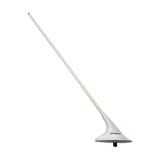
ELT/beacon and battery, dual-band whip antenna, two-wire remote switch, mounting tray and required installation hardware.
Can an existing ELT antenna be reused with the ELT 345?
No. ACR approves only two antennas for the ELT 345: the 23.4 in (594 mm) whip A3-06-2892-1 with 6 ft (1.8 m) coax, supplied in the 8102 kit, and the 15 in (381 mm) whip 110-773 for installations that need a shorter antenna. On composite or fabric-covered airframes a ground plane is fitted following AC 43.13-2B, and ACR does not allow the antenna to be painted.
How often is the battery replaced, and can it be done in the field?
By the date on its label, at the latest after its six-year useful life, and earlier after an emergency use, after an inadvertent activation of unknown duration or once transmissions total more than one hour. The replacement is the lithium manganese dioxide pack A3-06-2883, ordered as ACR P/N 8322. ACR allows ELT batteries to be replaced in the field; the new expiry date is marked on the transmitter and entered in the aircraft maintenance records.
Is the ELT 345 approved for installation in a certified aircraft?
It holds FAA TSO-C126b, which approves the equipment, not its installation, and ACR holds no STCs (supplemental type certificates) for installing it by aircraft type. Installation in a certified aircraft needs an approved modification (EASA STC or a minor or standard change where one applies) and a release to service. To check a specific aircraft, AIR TEAM needs the type, serial number and current avionics.
Does the ELT 345 have to be programmed for the country of registration?
Yes. The 406 MHz message carries the country code and either the beacon serial number or the aircraft identification or registration. ACR programs the ELT from a programming sheet supplied with the order; equipped dealers and ACR service centres can reprogram it later, for example after a change of registry. The beacon is then registered with that country's authority, and ACR asks for re-registration every two years.
Does the ELT 345 have its own GPS, and which units can feed it?
No, it has no GPS receiver of its own. The built-in RS-232 interface, which needs no aircraft power, accepts position data from an external source: NMEA 0183 at 4800 baud (GGA, GLL or RMC) or Aviation protocol at 9600 baud, as programmed, and only with a long-message protocol. Without that input the ELT still transmits, but the 406 MHz position is typically within 3 km instead of about 100 m.
Is the remote switch required, and does the kit include the wires to it?
The switch is required: the ELT 345 emergency locator transmitter must be installed with the two-wire switch A3-06-2759 supplied in the 8102 kit, or the slim A3-06-3214, and TSO-C126b makes the remote switch and buzzer mandatory. The harness wire is not in the 8102 pack list. The installer makes the two-wire harness from aircraft wire of at least 22 AWG (MIL-W-16878, M22759, M27500 or equivalent), shielding recommended.
Which ELT 345 programming does an aircraft registered outside the USA need?
The emergency locator transmitter (ELT) is programmed for the aircraft's state of registry, not for the countries where it flies: the 406 MHz message carries the country code of registration and the aircraft or beacon identification. ACR programs it from a programming sheet supplied with the ELT order, or the customer programs it with ARTEX equipment. If the aircraft is later registered in another country, the ELT is re-programmed and registered again.
Does the ELT 345 have its own GPS, and does it work without a GPS connection?
It has no GPS receiver of its own and works without a GPS connection. Without position data, ACR gives a typical 406 MHz location accuracy of 3 km; with position from the aircraft navigation system it improves to about 100 m. The built-in RS-232 input takes NMEA 0183 at 4800 baud or aviation protocol at 9600 baud, needs no aircraft power, and uses the data only with a long (location) protocol.
What does Compact Kit 8107 include, and how does it differ from kits 8102 and 8108?
Kit 8107 contains the ELT 345 with its battery pack fitted, the mounting tray, the 15 in (381 mm) whip antenna 110-773, a 6 ft (1.8 m) BNC coax cable, the standard two-wire remote switch, a buzzer, installation kit 455-7423 and an instruction sheet. The Standard Kit 8102 has the 23.4 in (594 mm) whip A3-06-2892-1 with its own coax instead, and the Slim Kit 8108 pairs the 15 in whip with the slim remote switch.
What wire is used between the ELT 345 and its remote switch?
At least 22 AWG aircraft wire meeting MIL-W-16878, M22759, M27500 or a commercial equivalent; ACR recommends a shielded harness against electromagnetic and radio frequency interference. The two-wire remote switch needs no aircraft power. The harness gets a drip loop at the ELT connector and a service loop at the switch. The remote switch and the buzzer are mandatory under TSO-C126b.
Can the ELT 345 replace an older ELT such as an ARTEX ME406 or 110-4?
Yes, with its own antenna and remote switch. ACR designed the mounting tray with a multiple-hole pattern for replacing older ARTEX, ACK, Kannad and Ameri-King ELTs and states that it fits 90% of existing ELT hole patterns. The ELT 345 may be installed only with components ACR approves for it: antenna A3-06-2892-1 or 110-773 and remote switch A3-06-2759 or A3-06-3214.
Orders, VAT, shipping → FAQ.
Packaging: All certified parts ship with proper documentation (8130-3, COC, or equivalent) in protective packaging.
Traceability: Full back-to-birth traceability available. Dual release (FAA/EASA) documentation included where applicable.
Shelf-life items: Items with limited shelf life are shipped with current certification and maximum remaining life.